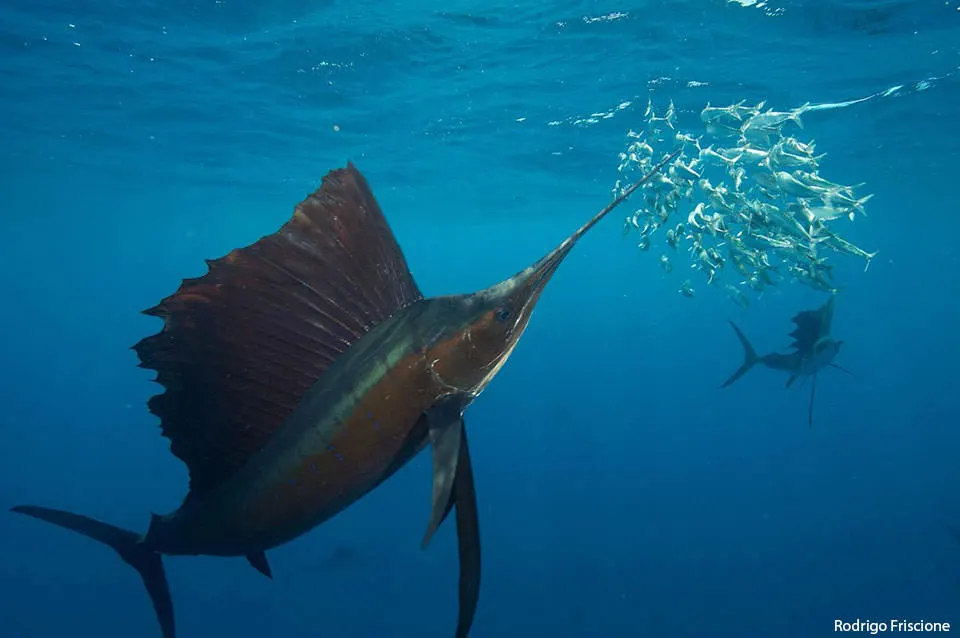
Sailfish
A warm-water billfish encountered less often than striped marlin around Cabo, recognized by its tall dorsal sail.
- Local Size
- Variable
- Fish vary widely
- Planning Window
- May–Jul
- Warm-water emphasis
- Fight Behavior
- Variable
- May jump repeatedly
- Conservation
- C&R
- Catch & release
Overview
Sailfish (Istiophorus platypterus) are named for the tall first dorsal fin that forms a “sail.” Hooked fish may make repeated, fast aerial jumps.
In Los Cabos, sailfish are less common than striped marlin and are generally treated as a warm-water target. They may be encountered while searching for other pelagic species.
Identification
The sail-like dorsal fin runs nearly the entire length of the back and carries rows of dark spots. The body is dark blue above and silvery below, often with iridescent hues. The upper jaw extends into a long, slender bill that may be used to strike schooling prey.
Sailfish are fast, streamlined predators built to pursue schooling baitfish in open water.
Seasonal planning
Sailfish are a warm-water possibility around Los Cabos. The June 2026 BCS sportfishing guide emphasizes May through July on the Pacific side; water mass, bait and current edges can move encounters beyond that range, so check recent reports.
Where crews look
Current edges
Look for bait and life where water masses meet; an edge on yesterday's image may have moved.
Open-water bait
Birds and visible bait can confirm activity, but wildlife and safe boat handling come first.
Named banks
Crews may search broad bank edges when current, bait and warm water line up.
Live reports
Let the captain choose a side and range from fresh observations and conditions.
Common techniques
Conservation
Planning a sailfish trip?
Compare warm-water reports, boat range, tackle and release practices.